Hi Tamby,
How did you place your access points? The AP-303 antenna pattern are optimized for horizontal placement on the ceiling. Wrong placement can lead to a bad coverage area.
Second we need to known what is the current EIRP tx-power. ARM will dynamic change the tx-power between its min. and max. value, depending on the interference in the air. Iám asume you got an Aruba Instant controller-less environment, the command to check the current tx-power is: "show ap debug power-table"
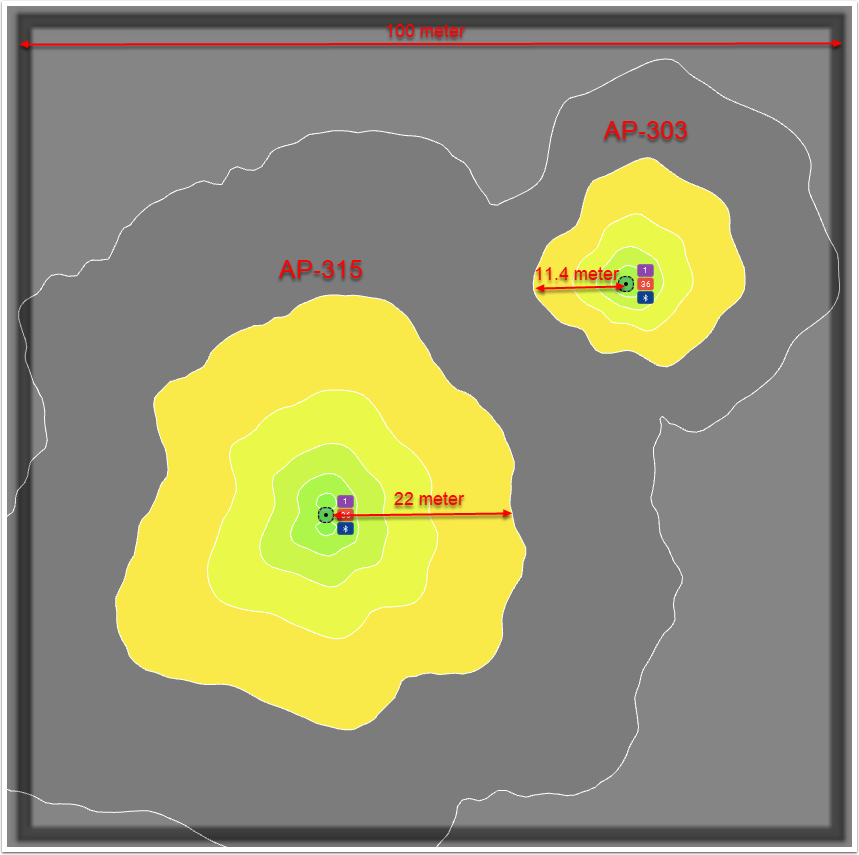
Another thing to mention is that when i calculate the cellsize in Ekahau you could clearly see that the antenna pattern is look like more a "cone formation" instead of a "donut". The AP-303 antenna push more power down to the floor instead of giving a bigger cellsize. The internal antenna's are somewhat looks like a patch antenna.
In the image below you see a square of 100x100meter in open air without walls, the AP-303 vs AP-315 are configured both with 5GHz@15dBM (30mW) EIRP tx-power. The cellsize is cutoff where the signal drop -65dBM@5GHz for a tablet like device. The AP-303 cellsize is at 11.4 meter, where the AP-315 cellsize is at 22 meter.
The AP-303 is a entry level AP for low density area's with 2x2:
2@2.4GHz and 3x3:3@5GHz.
The AP-315 is a standard office AP for medium density area's with 2x2:
2@2.4GHz and 4x4:4@5Ghz.
Hopefully you could win some cellsize by placing your AP's on the wall and tune the tx-power to a level that match your clients.
------------------------------
Marcel Koedijk | MVP Guru 2021 | ACMP | ACCP | ACDA | Ekahau ECSE | Not an HPE Employee | Opionions are my own
------------------------------